Upload Documents
Karomia uses your existing company documents to auto-populate data points in your sustainability report. Uploading comprehensive and relevant documents is the most important step to reduce manual editing time. The more relevant the documents, the better the AI-generated answers.
Upload all available documents before triggering the first AI run. Adding irrelevant files or multiple versions of the same document can lead to suboptimal results and increased manual work.
Accepted file types
- .docx — Word documents
- .pdf — PDF documents
- .pptx — PowerPoint presentations
- .xlsx — Excel spreadsheets
Upload categories
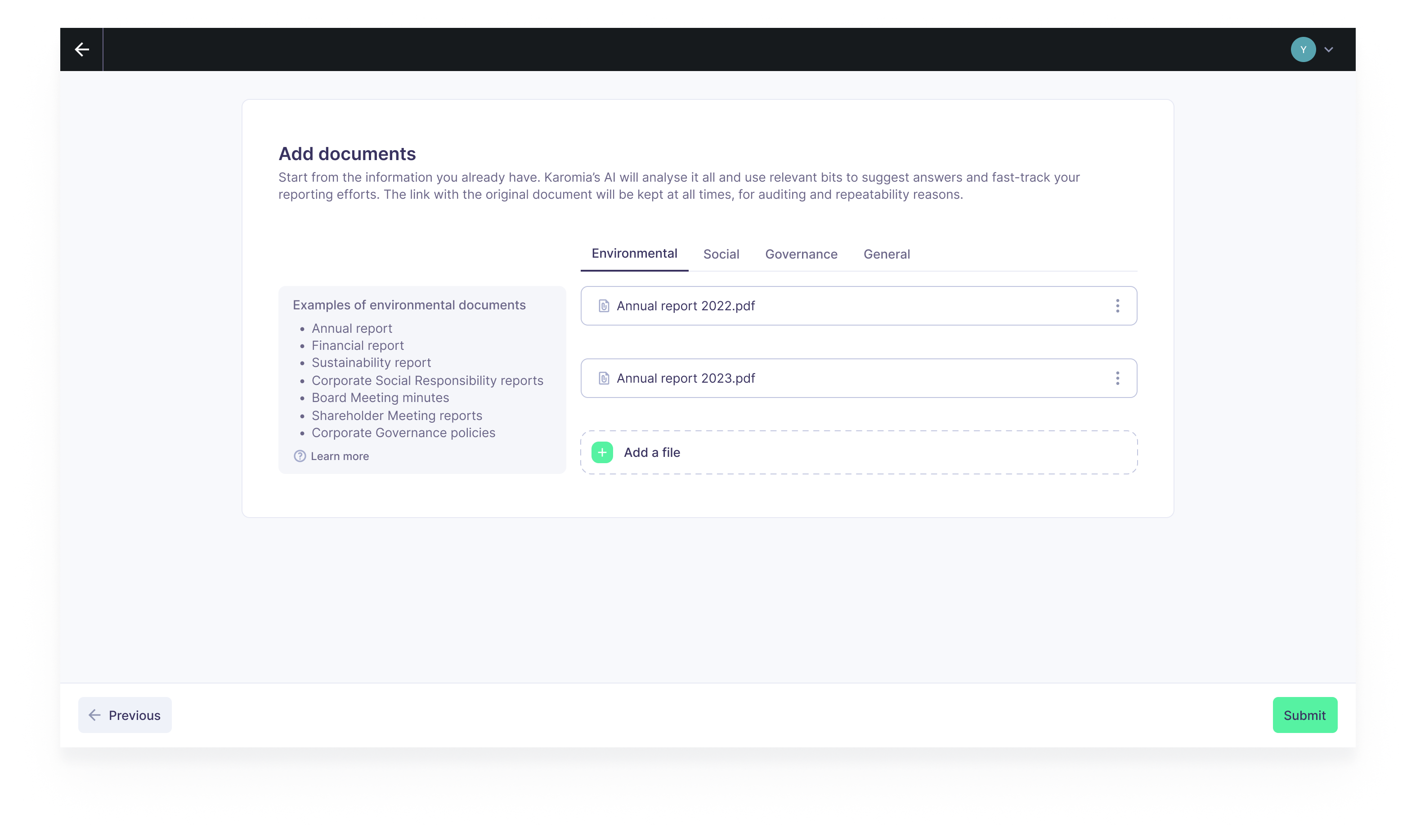
Documents are split into four tabs, each aligned with a reporting pillar.
Environmental
Upload documents related to ESRS topics E1–E5:
- E1 — Climate Change: Climate risk assessments, transition plans, GHG emissions data, energy consumption reports, carbon footprint analyses.
- E2 — Pollution: Pollution control plans, air/water/soil quality monitoring reports, pollutant release data, hazardous substance management.
- E3 — Water and Marine Resources: Water management policies, consumption and withdrawal data, wastewater treatment reports, marine resource impact assessments.
- E4 — Biodiversity and Ecosystems: Biodiversity impact assessments, habitat conservation plans, land use change documentation, ecosystem restoration reports.
- E5 — Resource Use and Circular Economy: Waste management reports, recycling rate data, material flow analyses, circular economy strategies, product lifecycle assessments.
Social
Upload documents related to ESRS topics S1–S4:
- S1 — Own Workforce: HR policies, employment terms, diversity and inclusion reports, health and safety records, training programs, employee surveys, works council agreements.
- S2 — Workers in the Value Chain: Supplier audit reports, supply chain due diligence, contractor labor standards, value chain worker engagement records.
- S3 — Affected Communities: Community engagement reports, social impact assessments, stakeholder consultation records, local development contributions, grievance mechanism documentation.
- S4 — Consumers and End-users: Product safety certifications, customer complaint records, data privacy policies, consumer satisfaction surveys, product labeling documentation.
Governance
Upload documents related to ESRS topic G1:
- G1 — Business Conduct: Code of ethics, anti-bribery and anti-corruption policies, compliance training records, whistleblower policies, political engagement disclosures, payment practices documentation.
General
Upload cross-cutting documents that inform multiple topics:
- Annual report
- Double Materiality Assessment results
- Corporate governance report
- Previous sustainability reports
- Risk management policies
- Stakeholder engagement documentation
- Company strategy and business model descriptions
Numerical value templates
For data points requiring numerical values (e.g., energy consumption, emissions figures, workforce statistics), Karomia provides downloadable Excel templates organized by ESRS topic. Each template is pre-structured with the exact fields and units needed, making it easy to collect and upload quantitative data in the right format.
How to upload
- Navigate to the Documents section of your report.
- Select the appropriate category tab.
- Click Upload or drag and drop your files.
- Add a description to help the AI understand each document's content and relevance.
- Click Submit to begin processing.
Once documents are submitted, they cannot be edited. Make sure your documents are final before uploading. Upload a corrected version as a new file if a replacement is needed.
Best practices
- Use the correct category — Placing documents in the right tab helps the AI prioritize relevant content for each topic.
- Include numerical data in Excel format — Use the provided templates for quantitative data to ensure accurate extraction.
- Don't over-upload — Irrelevant documents or duplicates reduce accuracy and increase AI processing time.
Next steps
- Review AI output — Once processing is done, review and improve the AI-generated answers.