Materiality Assessment (Mini-DMA)
Before sustainability scores can be calculated, Karomia runs an automated mini-DMA to identify which ESRS topics are material for each company. The results of this assessment determine which topics appear in the company's Sustainability Dashboard.
How it works
The process starts with an automated mini-DMA. This identifies which of the 10 ESRS topics are material for the company.
- The automatically selected topics are shown to the company.
- The company can add extra ESRS topics if needed.
- The company cannot remove any topics that were automatically identified as material.
ESRS topics
- Climate change
- Pollution
- Water and marine resources
- Biodiversity and ecosystems
- Resource use and circular economy
- Own workforce
- Workers in the value chain
- Affected communities
- Consumers and end-users
- Business conduct
Each topic in scope becomes one Sustainability Score on the company's Sustainability Dashboard.
How material topics are selected
Karomia assesses the company's activities and maps them to one or more industries. Each industry has a fixed set of material subtopics. Karomia then evaluates the specific company against the material subtopics of the sector(s) they belong to.
The result is presented in a materiality matrix inside your Sustainability Dashboard. There you'll find the automatically calculated materiality results for each of the subtopics as well as a rationale explaining the industry baseline vs the specific company's context.
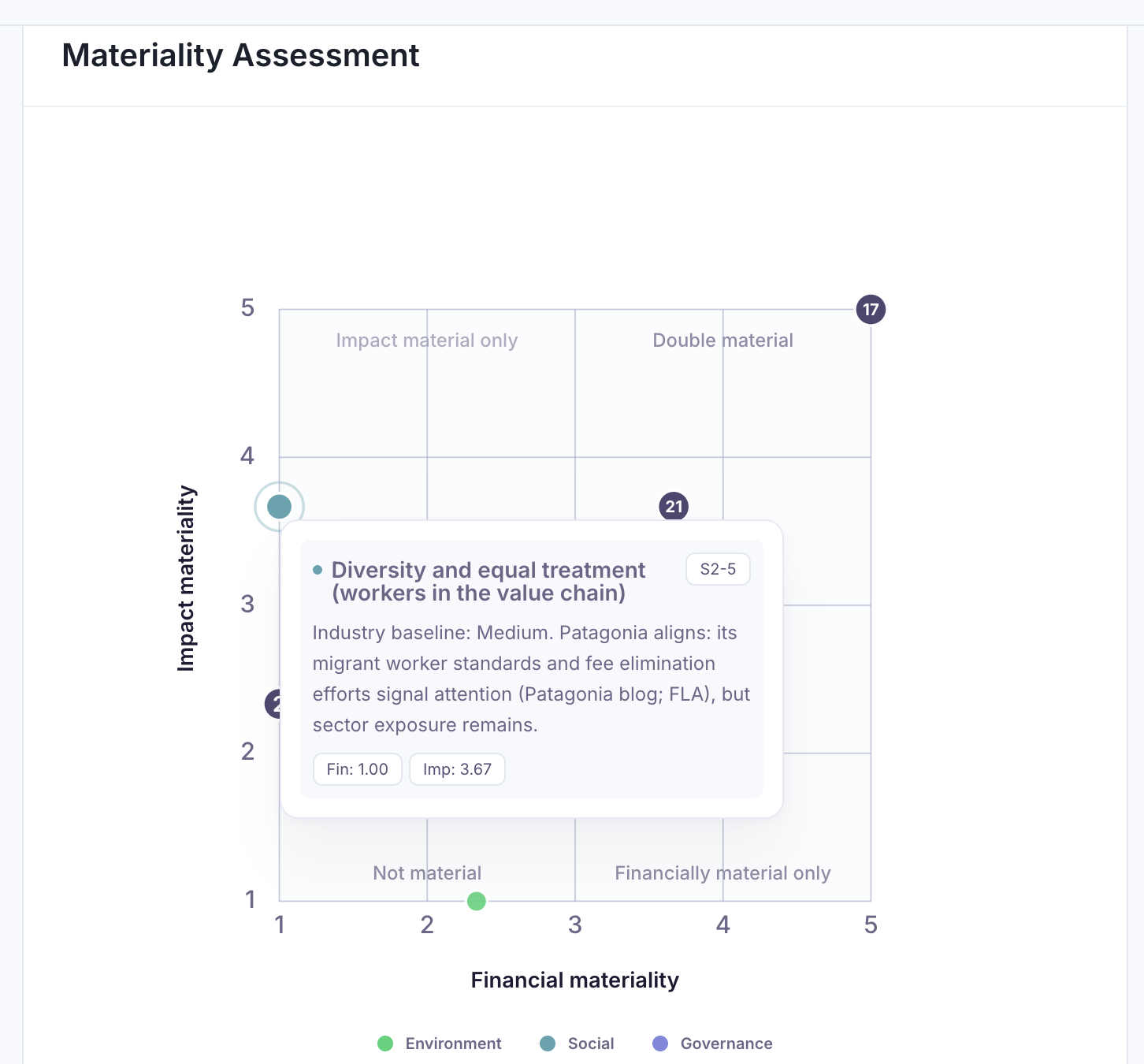
All subtopics with at least one score of 3 or higher are considered material. As soon as one subtopic is material, the topic it is linked to also becomes material.
Only material topics are included in the sustainability scores. If desired for a specific company, you can always include additional topic scores for topics that were found to not be material.